Search this topic, and you’ll notice something. Almost every guide on 3D product photography is published by a company selling 3D product photography services. So the conclusion never changes: 3D wins. Cameras are finished, so switch now. We run a photography studio, and here’s a different take. 3D isn’t a replacement for a camera. It’s a separate tool solving a separate problem. For a furniture brand with 40 fabric options, it’s obvious. For a skincare brand living on texture and light, it’s an expensive downgrade. This guide covers the cost, process, and benefits of 3D product photography with real numbers. Plus the section the vendors leave out. When traditional photography still wins.
What Is 3D Product Photography?
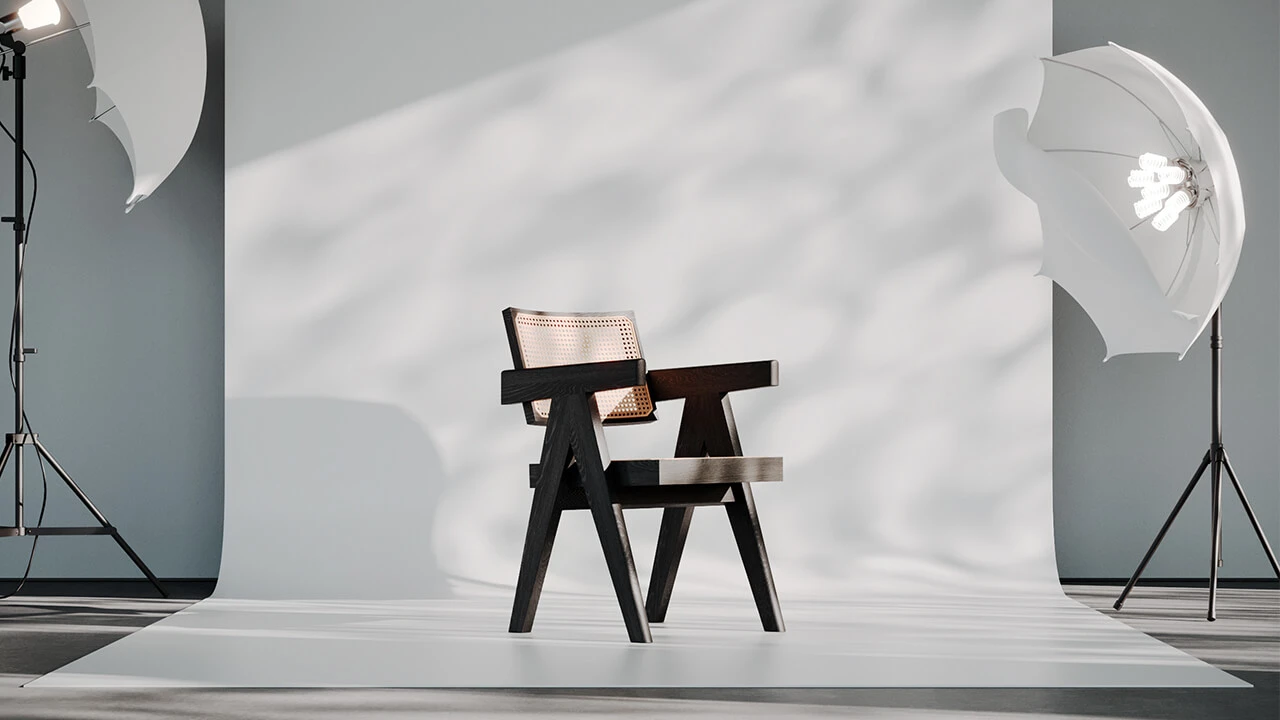
Credit: danthree.studio
3D product photography is the process of creating product images from a digital 3D model instead of a physical product.
You’ll also hear it called virtual photography, CGI, or 3D product rendering; it’s the same thing. Here’s the mental shift that makes it click. In a normal shoot, everything is physical. The product, the lights, the backdrop, and the camera.
With 3D photography, every one of those becomes a digital object you can move, change, or delete.
The product itself becomes what the industry calls a digital twin. That’s a highly accurate 3D model built to match the real item’s geometry, materials, and textures.
Once that model exists, you can “photograph” it from any angle. Any lighting, background, and color variant. At two in the morning, without touching a camera.
That’s the whole pitch, honestly. You build the product once digitally. Then you generate images from it forever.
3D Product Photography vs. 360 Product Photography
These get mixed up constantly. They’re not the same thing.
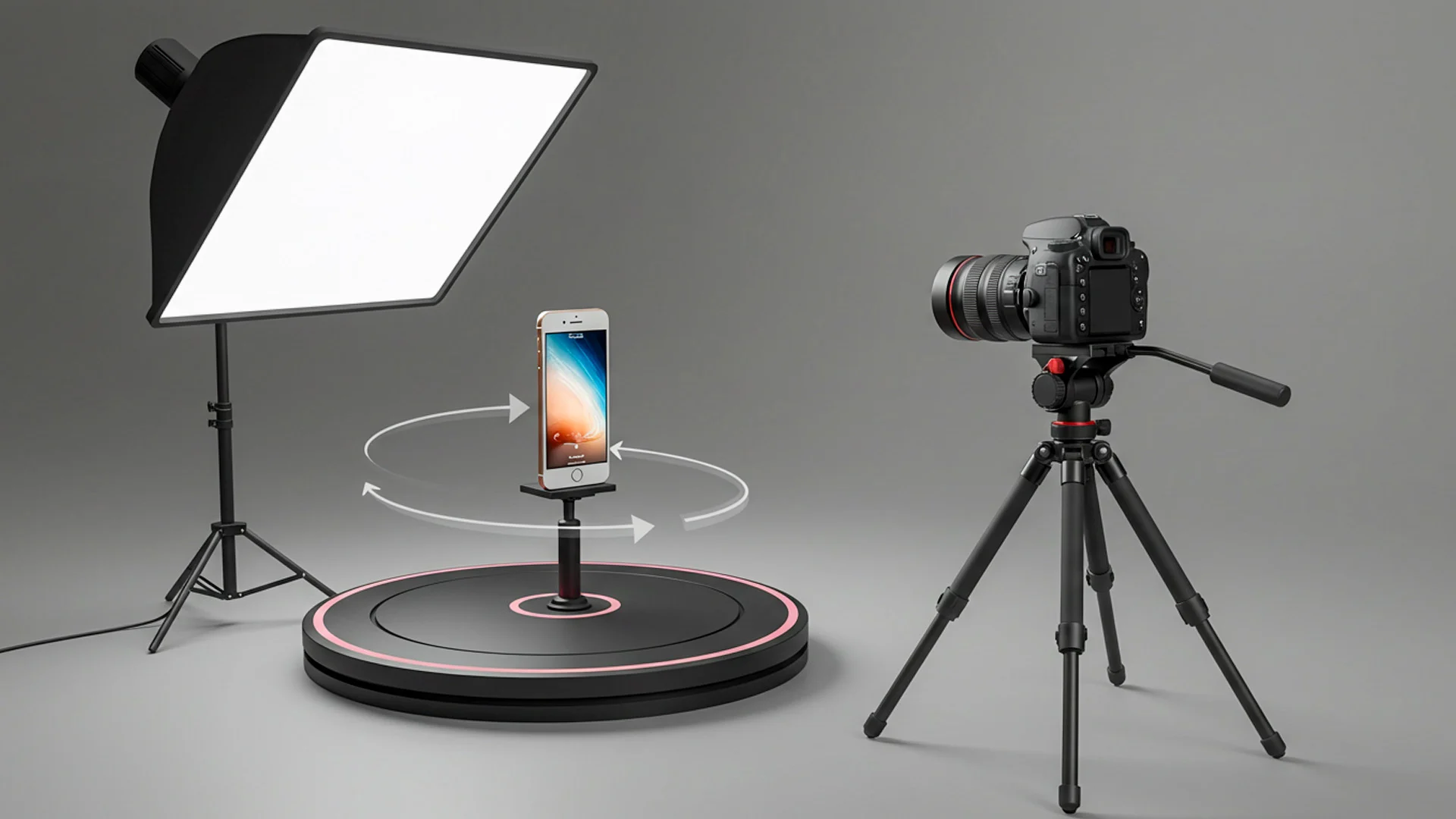
- 360 product photography, also called 3D product rotation photography, uses real cameras. The product sits on a motorized turntable. The camera fires at set intervals as it spins. Those frames get stitched into a spin the shopper can drag.
It’s real photography. You need the physical product, controlled lighting, and dedicated 3D product photography equipment.
That usually means a turntable, a synced camera rig, and a lightbox.
- 3D product photography uses no camera at all. Images are generated from a model by software.
One method needs a studio full of gear. The other needs a file.
Here’s the practical difference. A 360 spin is a fixed sequence of images. Want a different angle or a new color? Reshoot. With a true 3D model, a new angle is a click. A new colorway is a material swap.
One more distinction worth knowing. A 3D image is a fixed render for your listing. A 3D viewer is an interactive model the shopper rotates live on your page.
Same asset, two outputs.
How Does 3D Product Photography Work?

Credit: photigy.com
The workflow is more predictable than people expect.
1. Source the geometry. The studio needs your CAD files, technical drawings, or clear reference photos with real measurements.
CAD makes this faster and cheaper. Reference photos work fine, but the modeler is rebuilding your product from scratch.
2. Build the model. An artist recreates the shape, proportions, and components digitally.
This stage decides accuracy. A model that drifts from your real product creates returns, not sales.
3. Apply materials and textures. This is where cheap 3D falls apart.
Brushed aluminum, woven fabric, frosted glass, and suede all behave differently under light.
Getting these right takes more time than building the shape.
4. Set up the virtual scene. Lighting setup, camera angles, composition techniques, background options.
These are the exact same decisions a photographer makes on set. They just happen on a screen.
A good render artist thinks like a photographer, not a software operator.
5. Render and export. The software calculates the final image.
You lock resolution settings here based on where the image is going, since a marketplace listing and a printed catalog need very different files.
Quick technical note that’s worth understanding, because it explains why some renders look fake.
Ray tracing traces light rays as they bounce off surfaces and pass through materials. It’s fast and good for hard, glossy products.
Path tracing goes further. It simulates how light bounces between surfaces, fills shadows, and bleeds color.
It’s slower and much more expensive to compute. It’s also why high-end renders are now nearly impossible to tell from photos.
If a quote seems suspiciously cheap, this is usually where the corner got cut.
How Much Does 3D Product Photography Cost?
Credit: picsera.com
Quotes for the same product can vary by 10x. That confuses everyone.
The reason is simple. Most 3D product photography price quotes bundle two different line items into one number.
- Modeling is the one-time cost of building your digital twin. Simple products run roughly $40 to $150 per SKU. Complex ones with fabric, reflective surfaces, or fine detail run $200 to $800 and up.
- Rendering is the cost per image after the model exists. Basic renders start around $50 to $300. Photorealistic hero images for advertising run $300 to $2,000.
Now here’s the part that actually matters for your budget.
The first image of a product carries the modeling cost. Every image after that is dramatically cheaper.
A new angle is a camera move. A new colorway is a material swap.
That’s why a 60-SKU catalog never costs 60 times a single image. Studios typically discount 20% to 40% on catalog work of 50 SKUs or more. So the honest answer to “what does it cost” is another question. How many variants and angles do you need? One product with one image? 3D is expensive.
Forty products across six colorways and five required angles? The math flips hard.
The Biggest Cost Factors
Six things move a quote more than anything else.
- Product complexity. Reflective surfaces, transparency, and heavy fabric cost the most. Chrome, glass, and knitwear are the usual budget killers.
- CAD availability. If you have usable files, you skip a chunk of modeling. If not, someone builds it from photos.
- Number of variants and camera angles. Colorways, sizes, configurations, and each required viewpoint. Cheap once the master scene exists. Expensive if requested piecemeal later.
- Background options and styling. Plain white is cheapest. A full lifestyle environment costs several times more.
- Batching. Sending 50 SKUs at once costs less than 50 SKUs one at a time. Same work, better economics.
- Revision rounds. Ask how many are included before you sign. This is where budgets quietly leak.
What Are the Benefits of 3D Product Photography?
Credit: 3dphotographers.com
Six benefits hold up under scrutiny.
- You can create images before the product exists. This is the biggest one, and it’s underrated. As soon as your design is approved in 3D, imagery is ready. No waiting on samples or shipping. You can open pre-orders and brief retailers months earlier.
- Variants stop being a logistics problem. A sofa in 40 fabric combinations is a nightmare to shoot. In 3D it’s a batch job.
- Updates take hours instead of weeks. Change the model, regenerate the images. No studio booking, no sample shipping.
- One asset feeds every channel. The same model powers your product page, an AR view, a configurator, and video. Build once, use everywhere.
- Interaction lifts conversion. Shopify data reported to Harvard Business Review found AR-enabled products converted up to 94% higher. Threekit cites roughly a 13% lift from 360 viewers. Treat these as directional, not guaranteed.
- Fewer returns. Shoppers who can inspect a product from every angle guess less. Fewer surprises on delivery.
There’s a sustainability angle too. Fewer physical samples means less waste and less shipping.
Where Does 3D Product Photography Work Best?
There’s a pattern. 3D wins where variants multiply, and photography can’t keep up.
- Furniture. Multiple fabrics, finishes, and configurations per model.
- Automotive and industrial. Configurable products where shooting every combination is impossible. 3D is basically the default here now.
- Footwear and apparel with heavy colorways. Especially for pre-season and pre-order imagery.
- Jewelry and watches. Deep zoom on fine detail, plus custom configurations.
- Electronics. Clean hard surfaces render beautifully, and cutaways explain features well.
- Multi-channel sellers. Every retailer demands different specs. Presets handle it automatically.
Quick rule. If your product comes in many variants, or you sell through channels with different image requirements, or you need visuals before manufacturing, 3D pays off.
When Is Traditional Product Photography Better?
Credit: lightxeditor.com
Now the part the 3D vendors leave out.
- Small catalogs. One product, a handful of images? A shoot is faster and cheaper. You’ll never recover the modeling cost.
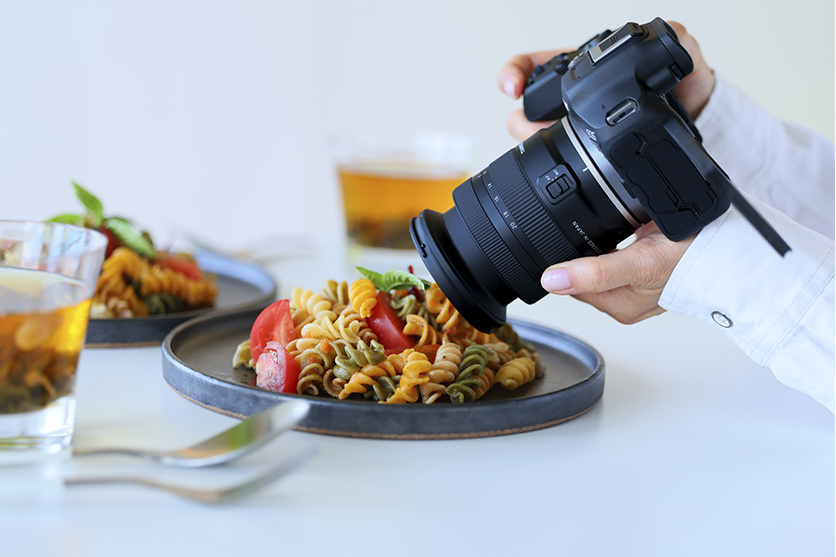
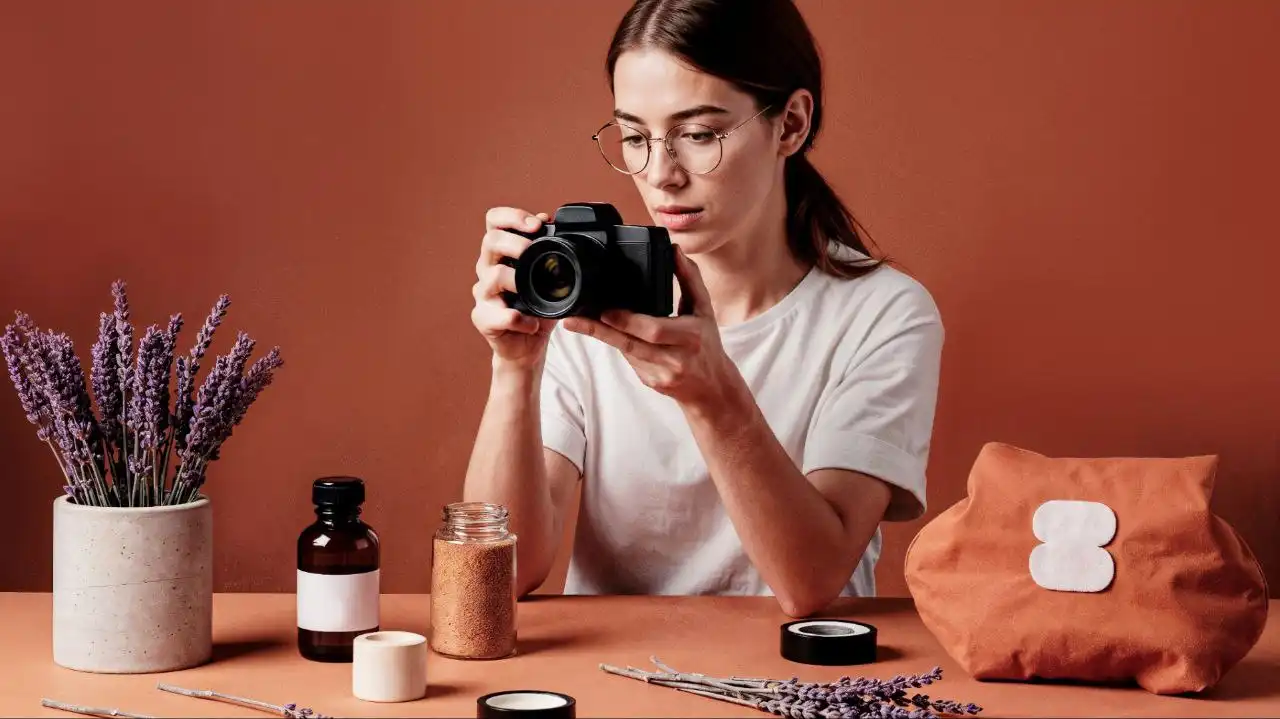
- Food, drink, and cosmetics. Condensation, crumb, foam, cream texture, and product-in-use moments. Good studio lighting captures this better and faster than a render ever will.
- Soft, draping, translucent materials. Loose fabric, sheer layers, liquids in glass. These are technically achievable in 3D, but they’re the most expensive things to model well.
- Live model usage. A person holding, wearing, or using your product. Hands, skin, natural expression. Photography still wins on believability, and by a wide margin.
- Authenticity signals. Some categories punish anything that looks synthetic. Handmade, artisan, and natural products often lose trust the moment shoppers sense CGI.
- Accuracy compliance. Marketplaces like Amazon require images to represent the actual product being sold. A render that flatters beyond reality is a listing risk.
- Speed for small batches. Ten products photographed in a day beats waiting on a modeling queue. Proven shooting techniques, plus same-week retouching techniques and color correction, get you listing-ready long before a 3D pipeline delivers its first frame.
Also worth flagging. 3D has real upfront cost, a learning curve, and file sizes that can slow your site if nobody optimizes them.
So, Is 3D Product Photography Worth It?
Answer three questions honestly.
- How many variants do you have? Under five per product, photography usually wins. Over twenty, 3D starts winning quickly.
- How often does your catalog change? Frequent launches and seasonal drops favor 3D. Stable catalogs favor a shoot.
- Do you need images before production? If yes, 3D is the only option. Photography can’t shoot a product that doesn’t exist.
Most brands land somewhere in the middle. And that’s fine.
The smartest setups we see use both. Photography for hero shots, lifestyle, and texture. 3D for variants, configurations, and pre-launch.
It’s not a rivalry. It’s a toolkit.
Ending Remarks
3D product photography is genuinely powerful when your catalog is large, variant-heavy, or moving fast.
It removes the logistics from image production and lets you sell before you manufacture.
But it’s a tool with a specific job. If you have thirty SKUs, no configurations, and products that live or die on texture and light, a camera will serve you better and cost you less.
Start with what you’re actually trying to solve. Then pick the method, not the trend.
If you’re weighing 3D product photography services against a traditional shoot for your catalog, talk to our team. We’ll tell you straight which one fits.
Frequently Asked Questions
Below is a roundup of questions that might be helpful if you are new to 3D product photography.
Is 3D Product Photography Actually Photography?
Not technically. No camera is involved. Images are generated from a digital 3D model using rendering software.
The name stuck because the output looks like a photo and serves the same purpose.
Will 3D Renders Look as Good as Real Photos?
For hard surfaces like metal, plastic, and glass, modern path-traced renders are nearly indistinguishable.
Soft materials, food, and skin are harder. Quality depends heavily on the studio’s material work.
How Long Does 3D Product Photography Take?
Modeling usually takes one to three weeks depending on complexity.
After that, new images and variants come back in days. The first SKU is always the slowest.
Do I Need to Buy 3D Product Photography Equipment?
Only for camera-based 360 spins, which need a turntable and a synced rig.
True CGI needs no hardware at all, just a 3D model and rendering software.
That difference alone changes your 3D product photography cost significantly.
Can I Use 3D Renders on Amazon?
Yes, as long as they accurately represent the product you’re selling.
Amazon’s rules are about accuracy, not method. Renders that exaggerate finish, color, or size are a compliance risk.
Check your resolution settings against each marketplace’s spec before uploading.
Do I Need CAD Files to Get Started?
No, but they help. With CAD, modeling is faster and cheaper.
Without it, clear reference photos from multiple angles plus real measurements are enough to build an accurate model.